-
Springtime Birdwatching in La Jolla Cove 🌸 (San Diego, CA)
April 10, 2021

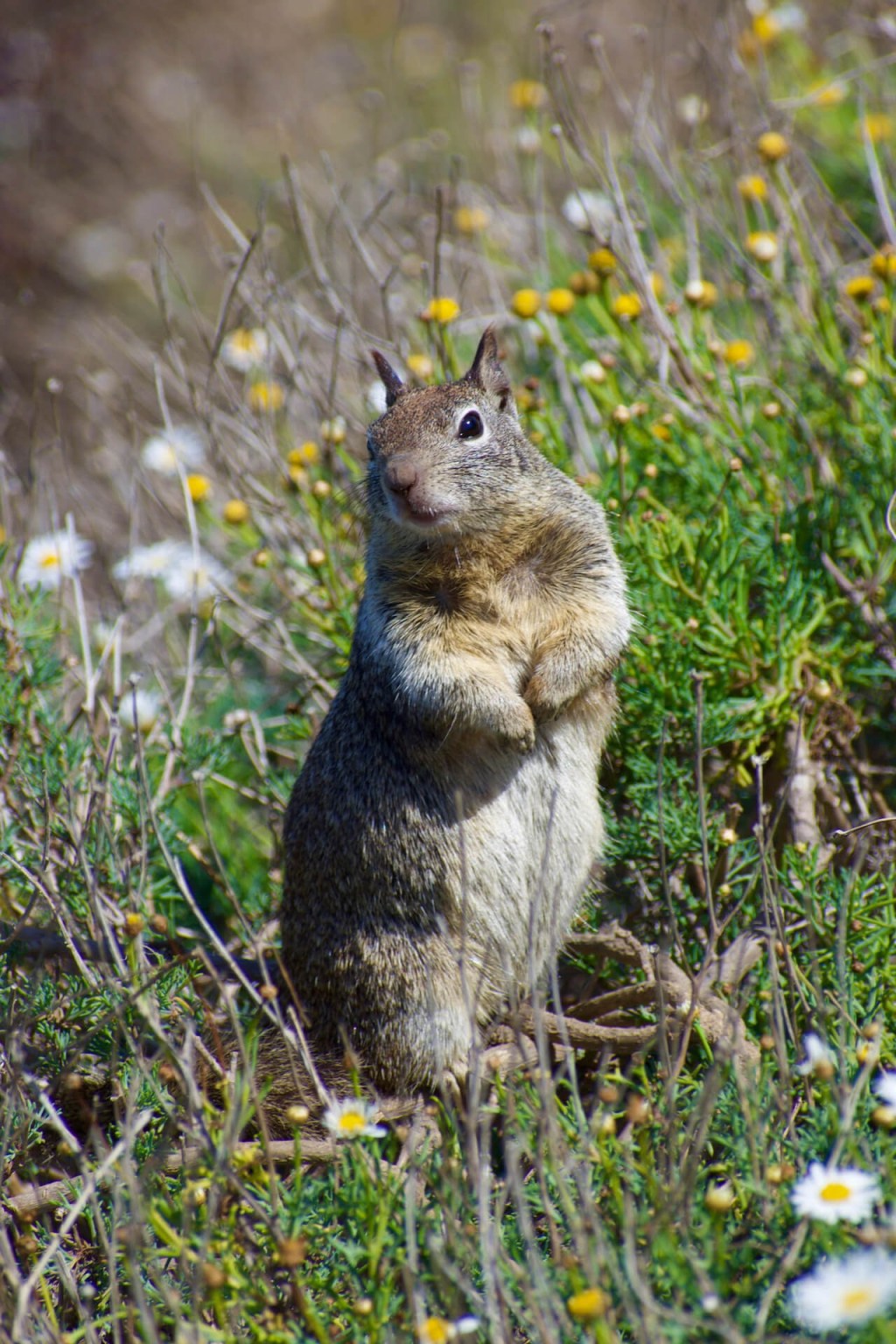
California Ground Squirrel (Otospermophilus beecheyi) April showers bring May flowers, but April also brings breeding cormorants and new life to La Jolla, California. La Jolla Cove is a popular tourist destination, primarily for its views of resident California sea lions scattered along the beach. Often overlooked are dozens of cormorant nests lying atop the surrounding rocky cliffs, filled with eggs and newly-hatched birds.
Six species of cormorants are native to North America. Brandt’s Cormorants and Double-crested Cormorants, both featured in this post, are found along the West Coast. Similar-looking at first glance, Brandt’s Cormorant’s golden-brown chin patch stands out quite a bit from the Double-crested Cormorant’s bright orange facial skin.
Adult Brandt’s Cormorants develop purple throat pouches during the breeding season, present on the adults in the photographs below.

Brandt’s Cormorants (Phalacrocorax penicillatus): Note adult’s purple throat pouch 
Brandt’s Cormorants (Phalacrocorax penicillatus): Note adult’s purple throat patch Double-crested Cormorants display tufts of white feathers on either side of their heads, as well as blue on the inside of their mouths, during the breeding season. The tufts and blue coloration disappear promptly after breeding, as do the Brandt’s Cormorants’ purple throat patches.

Double-crested Cormorant (Phalacrocorax auritus): Note white tufts on side of head 
Double-crested Cormorant (Phalacrocorax auritus): Note blue on inside of mouth Brandt’s Cormorants and Double-crested Cormorants are sexually monomorphic, meaning males and females look similar. Since both parents aid in incubating and feeding their young, it’s often difficult to determine who is mom and who is dad when both are present at the nest.

Brandt’s Cormorant (Phalacrocorax penicillatus) The Brandt’s Cormorant above was flying back and forth between ocean and land, delivering nesting material to his partner.

Brandt’s Cormorant (Phalacrocorax penicillatus) It was warm outside this particular day, so many of the cormorants stood with their bills open to release heat. In another effort to counteract heat, the Double-crested Cormorant above is standing over his or her eggs to protect them with shade. On cold days, breeding cormorants often stand on top of their eggs to incubate them with their webbed feet.

Brandt’s Cormorant (Phalacrocorax penicillatus) 
Brandt’s Cormorants (Phalacrocorax penicillatus) The little one photographed above took a nice afternoon stretch, exposing the fuzz on his young wings.

Brandt’s Cormorants (Phalacrocorax penicillatus) The two “teenagers” above seemed eager to leave the nest.

Brandt’s Cormorants (Phalacrocorax penicillatus) In another nest with restless “teenagers,” the Brandt’s Cormorant fledglings above stared intently at their parents for food.

Want the latest? Subscribe for email notifications!
-
Birding Fiesta Island (San Diego, CA)

April 6, 2021

House Finch (Haemorhous mexicanus), Male 
A tournament dedicated to Over-the-Line, a beach game resembling baseball and softball, has taken place on Fiesta Island in San Diego every July since 1954. For many, the tournament is essentially a summer beach party with beer, a bikini contest, and some friendly competition amongst thousands of participants. It’s not for no reason the tournament is coined “beers, babes, and bats on the beach.”
I’ve attended the tournament a couple of times but definitely didn’t think to return to the island for birdwatching. You can imagine my surprise when a fellow birder highly recommended Fiesta Island as a rewarding location to explore in San Diego.

Chestnut-collared Longspur (Calcarius ornatus), Male In the days leading up to my visit, reports of Chestnut-collared Longspurs at Fiesta Island flooded the San Diego Rare Bird Alert email listserv. These birds aren’t typically found in California but occasionally winter in the state until February or, rarely, late March. According to a report by well-known birder and author Paul Lehman, previous wintering Chestnut-collared Longspurs in the county “have never been seen later than February,” so finding one in April was unheard of.
One female and two males were seen the previous week, but I knew they would be departing north to their breeding grounds any day. Chestnut-collared Longspurs are sparrow-sized and often forage on the ground, so locating them would likely be like finding a needle in a haystack. Despite my reluctance, I had to at least try.
I set off for an area where I thought I might have the most luck and saw a man with binoculars and a large camera off in the distance. I made a beeline to the field he was scanning and asked if he had seen the longspurs. He said he hadn’t but was trying to find them as well.
After a few moments of silence, I noticed movement in the grass about 15 meters from where we were standing. I grabbed my binoculars and focused on a bird with a distinct rust-colored collar, a distinguishing characteristic of male Chestnut-collared Longspurs. I pointed my newfound birding companion to the potential Chestnut-collared Longspur and he confirmed the identification. A little birdwatching teamwork makes the dream work!

Song Sparrow (Melospiza melodia) One of the island’s Song Sparrows whistled his lively song from the top of a small boulder.

Marbled Godwit (Limosa fedoa) 
Willet (Tringa semipalmata) Meanwhile, Marbled Godwits and Willets fed along the water.
Want the latest? Subscribe for email notifications!
-
“Dancing Grebes” at Lake Hodges (San Diego, CA)

March 16, 2021

Clark’s Grebes (Aechmophorus clarkii) performing a Rushing Ceremony Courtship is a complex yet inevitable phenomenon in nature. While some animals are more extravagant than others in their efforts to impress potential mates, all use unique tactics to attract partners. Western and Clark’s Grebes are known as “Dancing Grebes” for their ballet-like mating rituals. Pairs join in synchronized head movements before skipping along the water in a Rushing Ceremony, as if they’re dancing across a stage.

Western Grebes (Aechmophorus occidentalis) 
Western Grebes (Aechmophorus occidentalis) The Western Grebes photographed above took turns bowing their heads against their backs for periods of several minutes in a synchronous courtship display. The moment one completed a bow and re-extended its neck, the other would descend into a bow and continue the pattern.

Clark’s Grebes (Aechmophorus clarkii) performing a Rushing Ceremony Some pairs then swiftly popped out of the water and ran side by side in a Rushing Ceremony, concluded by both birds diving into the water headfirst.

Western Grebes (Aechmophorus occidentalis): Note black below eye and yellow-green bill Western and Clark’s Grebes look almost identical to the naked eye, but a few key differences help differentiate the two species. Since they both occur in western North America and their ranges overlap almost entirely, telling them apart can be a useful (and fun) skill. Mind you, hybrids between these birds do exist, complicating things a bit.
The Western Grebe’s black crown extends below its eyes (photographed above). Further, note its yellow-green bill.

Clark’s Grebe (Aechmophorus clarkii): Note black above eye and orange bill The black crown on the Clark’s Grebe, on the other hand, does not extend below its eyes (see photo above). Instead, the feathers surrounding its eyes are white and its bill is significantly more orange than the Western Grebe’s.
Lake Hodges is a reliable location to observe “Dancing Grebes” in San Diego, but their mating behavior can also be seen throughout much of western North America. My GPS didn’t recognize an address for Lake Hodges, so I got a bit lost trying to locate the entrance. As much as getting lost is sometimes the best part of a journey, I’ll post directions below for reference. Happy birding!
Directions: From Interstate 15, exit Via Rancho Parkway and turn left on E. Via Rancho Parkway, turn left on Lake Drive, and continue to entrance.
Want the latest? Subscribe for email notifications!
-
Birdwatching at One of my Favorite Places on Earth: Farmington Bay (Farmington, UT)

February 26, 2021


My first trip to Farmington Bay was in February 2016 for Utah Bald Eagle Day, an annual event where biologists distribute carp at various wildlife hubs around the state. Not knowing what to expect but eager to see a Bald Eagle or two, my mom and I packed up binoculars and hit the blacktop first thing in the morning. We turned the corner onto the dirt road entrance and were greeted by dozens of Bald Eagles, along with an assortment of other raptors. We were both overcome with awe.
I returned in the spring of that same year. To this day, I have never seen so many different bird species in one place at the same time. The water and surrounding areas looked like a scene from a spring break beach party for birds. Farmington Bay quickly became my go-to spot while living in Salt Lake City and remains one of my favorite birdwatching destinations. Winter offers great looks at raptors, gulls, and waterfowl. Come spring, the bay is decorated with boatloads of shorebirds and songbirds. Either way, the place is a gem.
Fast forward five years, my mom and I set off on another lovely outing to Farmington, Utah. Farmington Bay’s straightforward layout is ideal for birding by car. As much as I like getting my boots dirty on foot, it’s nice every once in a while to sit back, relax, and watch birds from a comfortable chair.

Tundra Swan (Cygnus columbianus): Note yellow mark at base of bill The Tundra Swans photographed above will soon migrate thousands of miles to breed in the tundra of Alaska and Canada. They winter in the United States but only in a few areas, so I was happy to catch them before they begin their journey north. As depicted in the photograph, they typically congregate in flocks during winter months and disperse into pairs upon arriving at their breeding grounds in spring. They are thought to mate for life.

American White Pelicans (Pelecanus erythrorhynchos) in flight 
Northern Harrier (Circus hudsonius), Female: Note overall brown plumage, white rump 
Northern Harrier (Circus hudsonius), Female: Note overall brown plumage, white rump 
Northern Harrier (Circus hudsonius), Male: Note overall gray plumage, white rump 
Northern Harrier (Circus hudsonius), Male: Note overall gray plumage, white rump Northern Harriers’ bright white rump patches make identifying them a whole lot easier. In general, adult females have an overall brown plumage, while adult males are mostly gray. All maintain the telltale white rump, regardless of sex. Unlike most other raptors who rely primarily on eyesight to detect prey, they utilize both eyesight and hearing.

Bald Eagle (Haliaeetus leucocephalus) Seeing a Bald Eagle in person, I’m reminded of just how large they really are, even compared to other birds of prey.

Loggerhead Shrike (Lanius ludovicianus) Birds with hooked beaks typically consume a carnivorous diet, so the beaks on Loggerhead Shrikes have always stood out to me. In addition to insects, they also hunt small rodents, birds, and amphibians; an impressive feat considering their size.

Red-winged Blackbird (Agelaius phoeniceus) A special thanks to the male Red-winged Blackbird above who was calling out repeatedly, adding a pleasant jingle to the otherwise quiet morning.
Want the latest? Subscribe for email notifications!
-
Birding Joshua Tree National Park (Joshua Tree, CA)
February 19, 2021


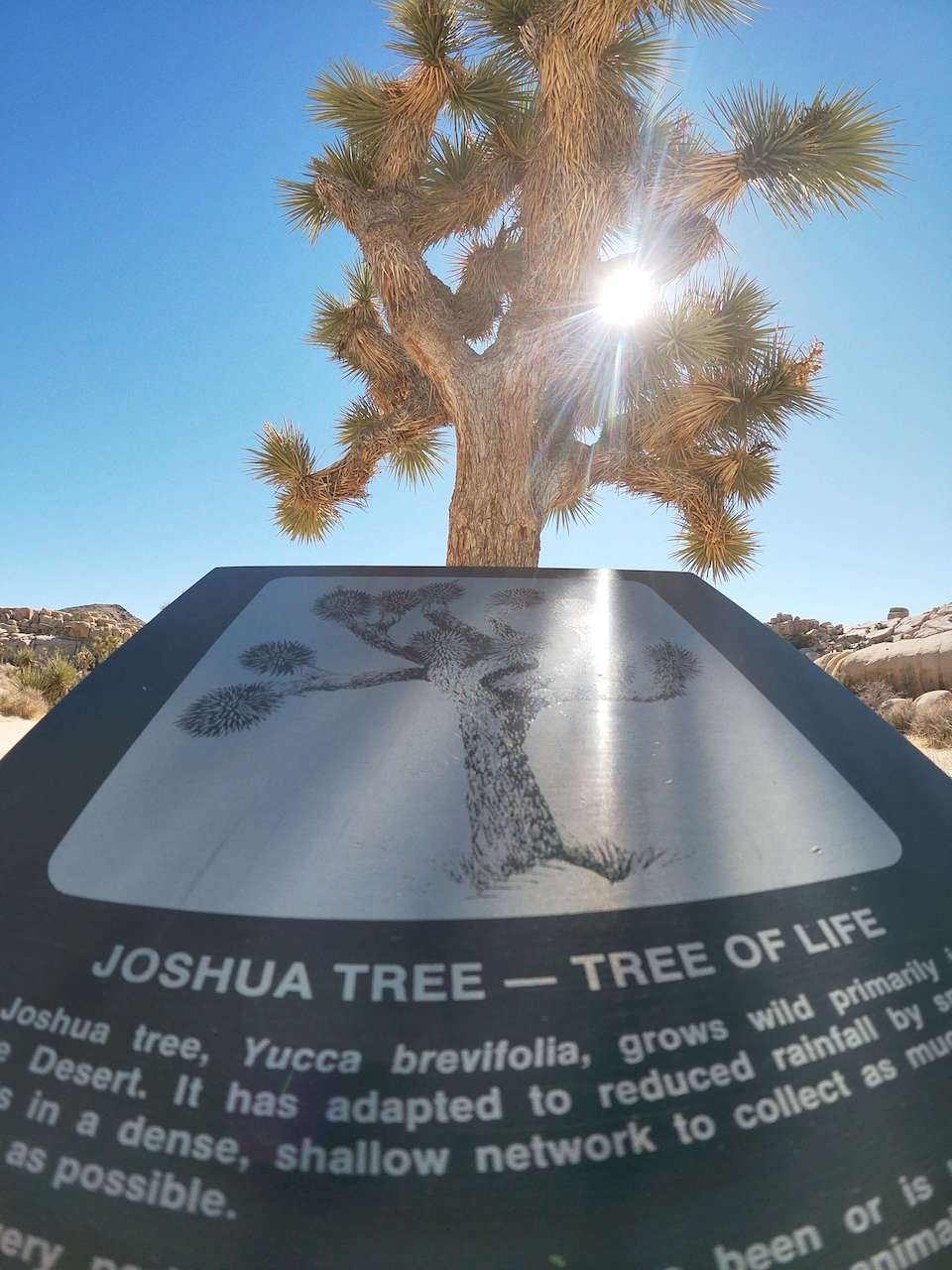
I was able to get out of Dodge earlier this week and drove east to Joshua Tree National Park, a tranquil patch of land hosting a plethora of birds by day and starry skies by night. As the name implies, the park is filled with a forest of Joshua trees; some skinny and tall, others dense and short. I’m overcome with a feeling of humility thinking about the Joshua trees standing quietly day after day, oblivious to worldly things like taxes, bills, and car insurance.
The western portion of Joshua Tree National Park is part of the Mojave Desert, while the eastern and southern areas are considered the Colorado Desert (a subsection of the Sonoran Desert). Driving through the park, it’s apparent when you’ve crossed over into the Colorado Desert because the Mojave Desert’s thousands of Joshua trees are replaced by wonderfully fragrant creosote bushes. It’s almost like an invisible line was drawn in the dirt, at which point the vegetation completely shifts. Like a lot of other living things, Joshua trees thrive at a specific elevation, so the invisible line is actually just an elevation gradient.
My sister and I camped at Black Rock Campground near the western edge of the park. I was in heaven waking up to birds hopping from tree to tree in the morning, but like clockwork there were hardly any in sight by 10 am. If that’s not motivation to wake up with the sun (and the birds), I don’t know what is.

California Thrasher (Toxostoma redivivum)
Black Rock Campground (Joshua Tree National Park)Thrashers in the genus Toxostoma (also referred to as typical thrashers) are unmistakable thanks to their long, curved bills. There are several species of this genus in North America, all sporting the iconic bill, but California Thrashers are found almost exclusively in California. They forage primarily on the ground, as seen in the photograph above.

White-crowned Sparrow (Zonotrichia leucophrys)
Black Rock Campground (Joshua Tree National Park)White-crowned Sparrows are another species that forages predominantly on the ground, oftentimes in groups. Identifying immature White-crowned Sparrows has tripped me up in the past because they lack the black-and-white crown and instead have brown stripes. Many other sparrow species have similar markings, so things can get confusing. I’ve started using their yellow-orange beaks as an identification tool because they have this characteristic regardless of age.

California Scrub-Jay (Aphelocoma californica)
Black Rock Campground (Joshua Tree National Park)
California Scrub-Jay (Aphelocoma californica)
Black Rock Campground (Joshua Tree National Park)Until relatively recently, three species of Scrub-Jays were recognized by the American Ornithologists’ Union: Island Scrub-Jays (found on Santa Cruz Island), Florida Scrub-Jays (found in Florida), and Western Scrub-Jays (found everywhere else). In July 2016, the Western Scrub-Jay was split into two species: California Scrub-Jays and Woodhouse’s Scrub-Jays. They look similar, but a few notable differences help differentiate the two. Woodhouse’s Scrub-Jays are a bit more muted in color and lack the bold contrasts seen in California Scrub-Jays. Range is also a helpful identification tool; California Scrub-Jays are found mostly along the West Coast, while Woodhouse’s Scrub-Jays reside throughout the interior of western North America.

Ladder-backed Woodpecker (Dryobates scalaris), Male
Black Rock Campground (Joshua Tree National Park)On our second day camping, I woke up to the sound of a woodpecker knocking on the stalk of a nearby Joshua tree. I unzipped the tent, grabbed my camera, and was able to capture a few photographs of a Ladder-backed Woodpecker. The similar-looking Nuttall’s Woodpecker has a red crown beginning further back on its head and dorsal markings that don’t reach its neck like the Ladder-backed Woodpecker’s.

Cactus Wren (Campylorhynchus brunneicapillus)
Quail Springs (Joshua Tree National Park)All I have to say about Cactus Wrens is… Arizona state bird, baby! Represent!

Horned Lark (Eremophila alpestris), Male
Geology Tour Road (Joshua Tree National Park)The photograph above is by no means the best I’ve ever taken, but I was excited to see this bird and wanted to include it anyway. Horned Larks have a beautiful facial pattern and although not displayed in the photo, the “horns” on the sides of males’ heads in spring are really interesting looking. My sister and I drove down a long, isolated dirt road for the better half of an hour and didn’t see a single bird the entire time. Out of nowhere and right before we were about to head back to camp, a flock of about 40 birds flew up from the ground in unison and landed, scattered across an expansive stretch of dried grass. I stopped the car and got out as fast as safely possible. They were Horned Larks! I tip-toed closer to the flock in hopes of spotting one close enough to photograph. As I took one more step, the entire flock flew up and landed again, this time 30 feet further. This happened a couple more times (I’d get 10 feet closer, they’d fly 30 feet further), so eventually, I figured I should leave them to their business.
Desert birds are without a doubt some of my favorites and I am deeply drawn to the peace and quiet the desert offers. There is something powerful about complete silence, the only sound being dirt crunching beneath your boots. You can take the girl out of Arizona, but you can’t take the Arizona out of the girl 😉.
Want the latest? Subscribe for email notifications!
-
Black Turnstones in Laguna Beach, CA

January 28, 2021


Victoria Beach is a magical little place that’s easy on the eyes to say the least. It’s located in Laguna Beach, right in the center of coastal Orange County. There were friendly lifeguards, cute Coppertone babies, a fairy-tale castle, and as an added bonus, a pair of very active Black Turnstones. These birds might look unassuming at first, but their dark plumage is quite distinct from other shorebirds.

Black Turnstone (Arenaria melanocephala) 
Black Turnstone (Arenaria melanocephala) 
Black Turnstone (Arenaria melanocephala) The pair was darting across the sand, feeding on top of seaweed beds and snagging crustaceans from rocks. They were completely uninterested in me and seemed to always have one eye on the water. They’d frantically search for food on whatever rock or seaweed bed they were standing on, look up to check the status of an approaching wave, go back to eating, then retreat to a “safe” spot just prior to getting drenched.
I’m a sucker for birds found exclusively in certain parts of the world. Black Turnstones reside strictly on western North American coasts. They winter along the Pacific coast, primarily in areas with rocky habitat, and head north to their breeding grounds off the coast of Alaska in the spring. Their non-breeding plumage is displayed in the photographs above. Note their solid dark backs, breasts, and heads, with stark white underparts. They develop white patches behind their bills during the breeding season, as well as streaks of white throughout their usually all-dark heads and breasts. The white stripe down their backs is seen in all plumages and is especially dramatic in flight.
I didn’t have my binoculars (or glasses) with me when we first arrived, so I wasn’t able to identify the turnstones until we took a trip back to the car to retrieve my camera. All I knew was they appeared much darker than birds in the usual shorebird crowd. I’m certainly grateful they stuck around long enough for me to sneak in a couple of shots.
Want the latest? Subscribe for email notifications!
-
San Diego Lake Crawl: Lake Murray, Santee Lakes, Lindo Lake
January 21, 2021

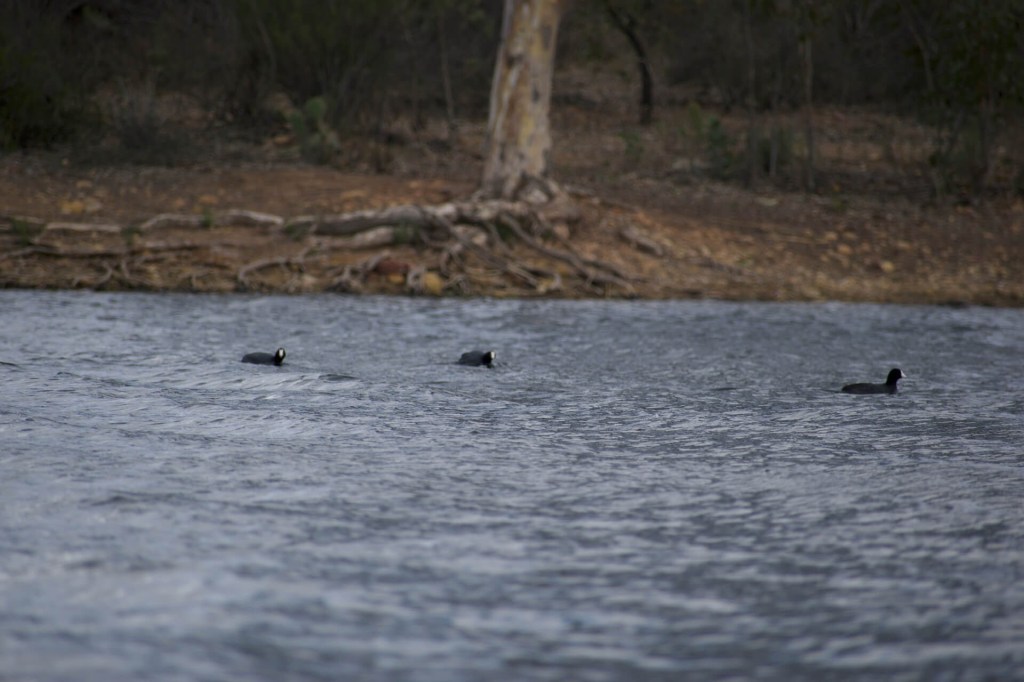
American Coots (Fulica americana) braving the storm at Lake Murray I recently embarked on a “lake crawl” involving three birding hotspots, one of which I was familiar with (Lindo Lake) and two new ones (Lake Murray, Santee Lakes). These three locations are easily accessible and sometimes produce rarities without having to go far. At the very least, I wanted to pay them a visit since they are mentioned so frequently in San Diego County birdwatching alert emails.
The day of the “lake crawl” was windy, cold, and cloudy. I almost talked myself out of going, making up excuses about how the lighting wouldn’t be suitable and how I probably wouldn’t see birds because it was supposed to rain. I went anyway and, as these things usually go, it was a marvelous day for birding.
Lake Murray

Turkey Vulture (Cathartes aura) Identifying birds of prey can be tricky because of the subtle differences in plumage and body shape between species. Turkey Vultures have a striking two-toned appearance which makes them relatively easy to identify, even from a distance. When I looked up and saw a dark raptor with white flight feathers soaring above Lake Murray, I immediately thought Turkey Vulture. Their talons differ from other raptors in that they are blunted and not adapted for grasping prey. This contributes to their obligate scavenger behavior, meaning they only eat things that are already dead. To make up for their lack of sharp talons, they have a keen sense of smell and wings optimized for low-soaring. According to studies published thus far, they’re the only vultures in North America who utilize their sense of smell for foraging.
 2[/url] by [url=https://www.flickr.com/photos/191969396@N03/]Gone Birdin'[/url], on Flickr)
California Towhee (Melozone crissalis) California Towhees have a relatively small range, residing year-around along the Pacific Coast. Most of the times I’ve seen them they’ve been foraging solitary on the ground, exposing their rust-colored faces and rumps.

Scaly-breasted Munia (Lonchura punctulata)
Upper Left: Female, Lower Right: MaleI was elated to find a male and female Scaly-breasted Munia perched near a section of scrub-shrub habitat. These birds remain a popular cage bird but are also naturalized in coastal California, the Dominican Republic, and the Gulf Coast. The idea that this species is native to southern Asia but managed to establish successful populations around the world after escaping cages fascinates me.

Great-blue Heron (Ardea herodias) Santee Lakes
Next stop: Santee Lakes. This location is only a few miles north of Lake Murray, so definitely still “in-town.” Santee Lakes is comprised of seven lakes total, but from what I could see, it looked like there was a fee for car access to Lakes 2-7. I parked at the front entrance of the park and walked to Lake 1 to check it out. A flock of Northern Shovelers caught my eye.

Northern Shovelers (Spatula clypeata) feeding 
Northern Shoveler (Spatula clypeata), Male I love the way Northern Shovelers’ green heads contrast against their white and rust undersides… and those yellow eyes! The Northern Shovelers at Santee Lakes (approximately 30 of them) were swimming with their heads submerged in the lake. It was to the point where finding a moment where one had its head raised was difficult. I laughed at the thought of them having their “heads buried in the water” instead of the sand, as the old saying goes.

Snowy Egret (Egretta thula) While sitting against a tree photographing the Northern Shovelers (or at least trying to), a Snowy Egret approached and stood within two feet of me. It was a bit unsettling how comfortable the bird was in my presence, as I’m used to seeing these birds in more of a wild setting. I will say… I can’t complain about the photo opportunities. Those bright yellow feet against their black legs remind me of yellow rain boots and are a great ID tool.

Double-crested Cormorant (Phalacrocorax auritus) drying wings My first memory of a Double-crested Cormorant was years ago with my sister at Chaparral Park in Scottsdale, Arizona. We noticed lanky, dark birds standing like statues with both wings extended; I remember thinking they looked really goofy. We located them in my field guide and read something along the lines of, “‘Wing-spreading’ is a technique Double-crested Cormorants use to dry their feathers after swimming, as they lack waterproof feathers” (Cornell Lab of Ornithology). The bird on the left in the picture above is exhibiting wing-spreading behavior.

Double-crested Cormorants (Phalacrocorax auritus) roosting Around sunset I found a flock of Double-crested Cormorants roosting in a single tree by the water. Cormorants, egrets, and herons spend most of their time on land or in water, so they looked a bit out of place sitting in a tree. Not to mention, watching their crash landings onto branches was an experience in and of itself.

Wood Duck (Aix sponsa), Male 
American Coot (Fulica americana) American Coots are widespread across North America and I’ve observed my fair share of them, yet I’m enthralled at each encounter by their ruby red eyes and fleshy, chicken-like feet.
Lindo Lake
Lindo Lake is a lovely neighborhood lake with no shortage of birds. The last time I was there I was drawn to a large number of Red-crowned Parrots vocalizing outside of a house abutting the lake. Their call is a surprisingly loud squeaky-toy noise and they seem to feed off of each other once one starts calling out. I wonder if the person who bought that house realized a local flock of parrots would have an affinity for the tree in their front yard. I’d consider it good luck.

Snowy Egret (Egretta thula) The Snowy Egret photographed above had noticeably erect feathers, a visual display of aggression, after warding off other birds from eating his food. They are combative when it comes to obtaining and protecting food sources. One second they’ll be viciously hunting, fending off any species within a stone’s throw away, and the next second they’re standing peacefully in the sand staring off into the sunset. They’re funny birds who I think of as the similar-looking Great Egrets’ little punk cousins.

Black-crowned Night Heron (Nycticorax nycticorax), Juvenile 
Black-crowned Night Heron (Nycticorax nycticorax), Adult The differences in appearance between immature and adult Black-crowned Night Herons, photographed above, are dramatic. Although not seen on this particular day, a bird called a Yellow-crowned Night Heron occurs primarily in eastern North America but sporadically creeps into the West. Juvenile Black-crowned Night Herons and juvenile Yellow-crowned Night Herons look almost identical, but can be differentiated by the Yellow-crowned’s all-black bill.

Common Gallinule (Gallinula galeata) Common Gallinules resemble American Coots in their chicken-like body structures, but have beautiful orange shields on their foreheads with matching bills. As if their bills weren’t enough of an identification tool, the bold white stripe along the sides of their wings is a nice giveaway as well.

American White Pelican (Pelecanus erythrorhynchos) There are two species of pelicans in North America: the American White Pelican and the Brown Pelican. Luckily, they look different enough that discerning between the two is fairly simple. The American White Pelican’s plumage is stark white with jet-black flight feathers. On the other hand, Brown Pelicans are all dark with either brown (Atlantic Coast) or bright-red (Pacific Coast) skin on their throat pouches.
Want the latest? Subscribe for email notifications!

