-
Birdin’ the Hamptons: Common Eider in Montauk, NY
January 10, 2022

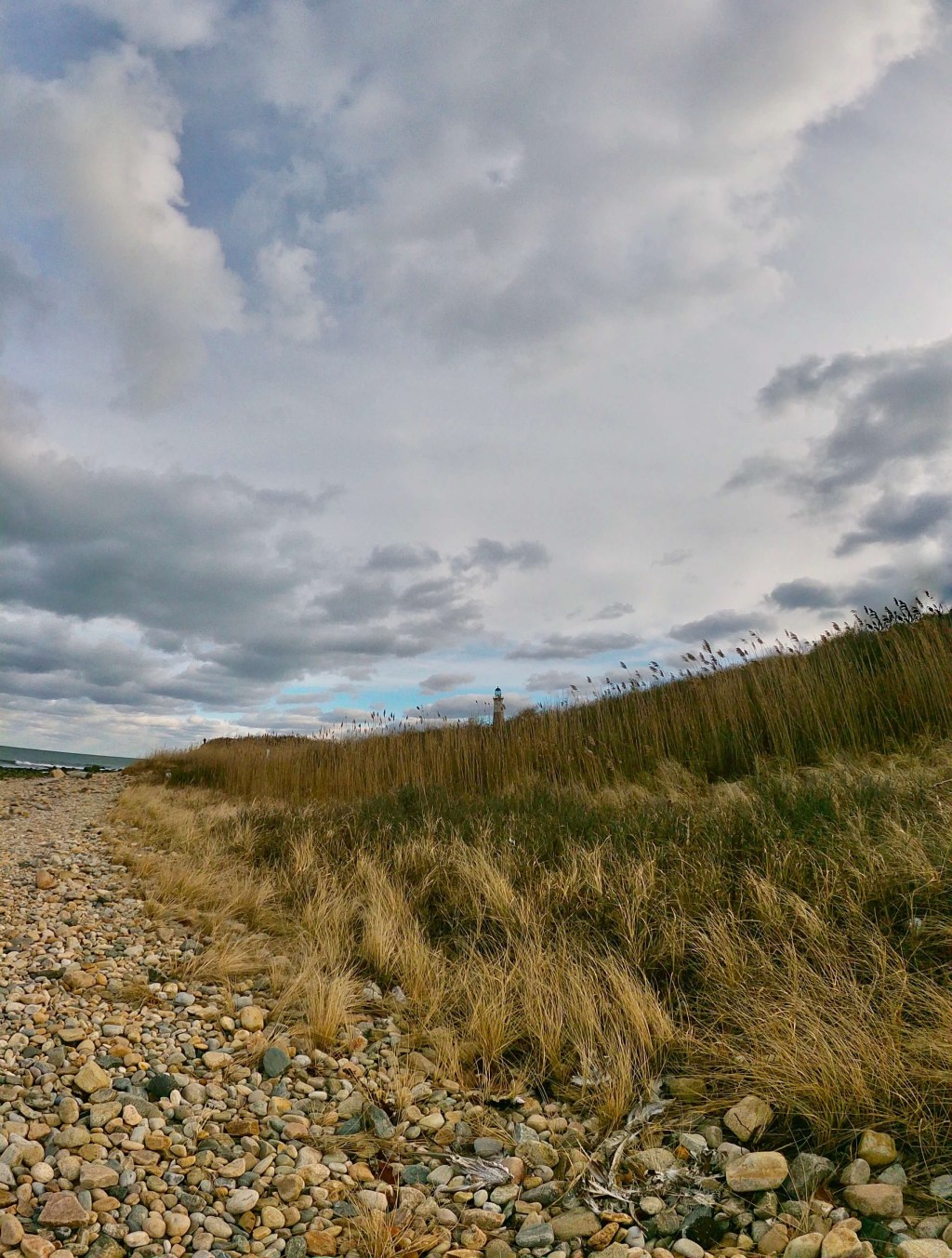
Montauk Point Lighthouse Life has carried me through some serendipitous twists and turns the past few months. I’d never heard of Montauk, NY or a Common Eider, yet there I was birdwatching at the edge of Long Island at Montauk Lighthouse.
Crisp wind created violent turbulence in the ocean and left my nose bright red. Unfazed by the rough waters, a bird whose bill reminded me of a dog snout was busy fishing. I speculated she was a scoter of some sort because of her peculiar bill, but I wasn’t sure.

Common Eider (Somateria mollissima), Female I eventually landed an ID for the bird with the help of the World Wide Web: a Common Eider. This wasn’t the first time I’d been stuck on an identification, only to find out “common” was ironically in its name. Common Eiders are typically only found along the coasts of Alaska, Canada, Greenland, and the Northeast, so I suppose it’s no wonder it was outside of my wheelhouse.

Common Eider (Somateria mollissima), Female The Common Eider actively swam and bobbed on top of the rocky water, all while avoiding menacing gulls trying to steal her food. After 20 minutes of strenuous diving, she emerged with a crab clenched in her beak. What a skilled fisherman she was! The crab’s pincher is hanging out of her mouth in the photo below…

Common Eider (Somateria mollissima), Female …but it wasn’t long before she swallowed it whole.

Common Eider (Somateria mollissima), Female 
Want the latest? Subscribe for email notifications!
-
Birding the Isla Vista Beaches 🐚 (Santa Barbara, CA)

December 28, 2021

Marbled Godwit (Limosa fedoa) 
Marbled Godwit (Limosa fedoa) Birdwatching evokes a blissful, meditative state in me like few other activities can. Something about walking in silence with my eyes and ears peeled erases every thought from my mind. Add the sounds, textures, and colors of the beach and time might as well not exist.
Days before the New Year, I was able to spend an afternoon birding the Isla Vista beaches in Santa Barbara, CA. It was just before sunset by the time I arrived, the sun casting a warm glow on shorebirds as they fed along the water.

Sanderling (Calidris alba) 
Semipalmated Plover (Charadrius semipalmatus) Several Semipalmated Plovers propelled their little legs across the sand, pausing momentarily every couple of minutes to look around. I’ve never really thought of birds as cute, but I’m not sure how else to describe a Semipalmated Plover’s mouselike scurry. It’s funny how “normal-sized” their miniature bodies look without other shorebirds in the shot for perspective.

Black-bellied Plover (Pluvialis squatarola) In other plover news, a Black-bellied Plover was standing solitary nearby. I like how his feet are sinking into the wet sand in the shot above.

Long-billed Curlew (Numenius americanus) 
Long-billed Curlew (Numenius americanus) I used to look at shorebirds with long, decurved bills and wonder, “How will I be able to tell if it’s a Long-billed Curlew?” If I could go back in time I would tell myself, “Trust me, you’ll know.” Their bills are unmistakable.
A note about Isla Vista: The beach is vast, but typically fairly populated due to its close proximity to the university. It was desolate the last week of December, so it seems a visit during winter break might be best for birdwatching.
Want the latest? Subscribe for email notifications!
-
Birding Lake Los Carneros (Santa Barbara, CA)
December 26, 2021
My last two bird outings of 2021 were to a couple of highly regarded spots in Santa Barbara, CA.
The first was to Lake Los Carneros. Easy-peasy with a meadow, a lake, and a nice assortment of birds. Love it. A parking lot is available for visitors which leads to a nature path circling the lake.

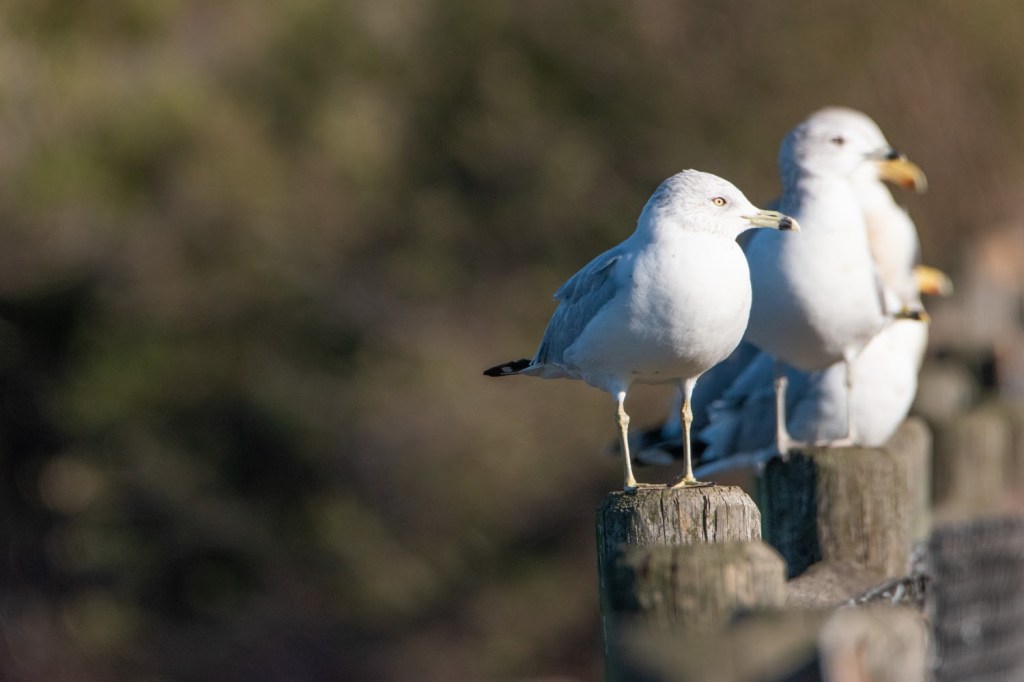
Ring-billed Gull (Larus delawarensis) A male Common Yellowthroat was quite literally the highlight of the day with his highlighter-yellow feathers. He was shy, spontaneously disappearing into a shrub before I could photograph him. Fortunately, an elegant Black Phoebe came to the rescue.

Black Phoebe (Sayornis nigricans) 
Black Phoebe (Sayornis nigricans) 
California Scrub-Jay (Aphelocoma californica) There was no shortage of California Scrub-Jays in the area. What’s for lunch today, Mr. Scrub-Jay?

Song Sparrow (Melospiza melodia) 
Red-shouldered Hawk (Buteo lineatus) The Red-shouldered Hawk above caused quite a stir amongst visitors walking the path. He stood motionless, his gaze locked on potential prey in a field of tall grass. Eventually he took his shot, gliding just above the grass with his talons extended. The poor feller wasn’t holding anything when he flew back up.

Cedar Waxwing (Bombycilla cedrorum) On the way back to the parking lot, I found myself on a residential road off the beaten path. There was a church to my left with a few trees planted in a vast grassy area. You can imagine the look of sheer glee on my face when I realized that the trees were filled with Cedar Waxwings.
If there were ever a “cool guy” of the bird world, I think Cedar Waxwings would be a major contender. Between their flashy pops of color, ninja-like masks, slicked back crests, and overall airbrushed appearance, they have prom king written all over them.

Western Bluebird (Sialia mexicana) To cap off the day, a Western Bluebird– my first love.
Want the latest? Subscribe for email notifications!
-
Wilson’s Snipe at Ken Malloy Harbor Regional Park (Los Angeles, CA)

December 21, 2021

Wilson’s Snipe (Gallinago delicata) Several months ago I divided my life list up into years. In a way, the numbers told a story as to what was going on in my life at the time. Some years I saw 50 new bird species, while others yielded far less. I saw 51 new species in 2019, the most I’d ever seen in one year. With a few months still remaining in 2021, I decided right then and there I was going to break my record. I realize my priorities might be out of whack, but I don’t know if I’ve ever been so wholeheartedly intent on accomplishing something in my life. Looking back, I think reaching 52 new species was more symbolic than anything.
Fast forward to late December with only nine days left in the year, I still needed to see four new birds. Sifting through local bird sightings in bed, I saw a report for a Wilson’s Snipe at Ken Malloy Harbor Regional Park. I’ve always wanted to see this species, partly because of the name and partly because of its unusual appearance. I woke up sleepy-eyed at 6 am and quietly began preparing my camera for the day. Before heading out, I whispered my sister’s name to see if she’d wake up. When she half-opened her eyes, I asked if she wanted to join me on my Wilson’s Snipe quest. She had work later in the day so I wasn’t expecting her to say yes, but she jumped out of bed without hesitation. My sister rocks.
I read somewhere that Ken Malloy Harbor Regional Park is the third largest park in LA. It’s huge, lending an extremely elusive bird such as a Wilson’s Snipe plenty of places to hide. The reports I saw the day before included photos of the snipe in reeds, which were presumably by the park’s expansive lake. My sister and I walked and walked, keeping an eye out for movement along the water’s edge. Two hours passed and we still hadn’t seen any snipes. Mind you, it was a chilly, cloudy day and I started feeling guilty for dragging my sister into such a thankless activity. We decided to try for another thirty minutes, at which point we’d throw in the towel and say, “at least we tried.” In a last-ditch effort, we returned to one of the several fishing piers with reeds underneath. I scanned underneath the pier and my sister ventured over to a nearby area with binoculars. I heard her say, “DUDE…” as she pointed to a figure in dense foliage. IT WAS A WILSON’S SNIPE! We relocated for a better view and saw five more. I was overcome with love and excitement; all I could do was hug her.
For the record, I ended up meeting my goal over the next few days with a Short-billed Gull, Band-tailed Pigeon, and Mute Swan. Sharing such a special memory with my sister was the cherry on top.
Want the latest? Subscribe for email notifications!
-
Birding Central Park 🚕🌳 (New York, NY)

December 2, 2021
This post is dedicated to my father, whom my love for is as bright as hibiscus and as endless as the sky.


Wollman Rink 
The Pond 
Jacqueline Kennedy Onassis Reservoir 

Feral Pigeons (Columba livia domestica) I step outside into the beautiful amalgam of order and chaos that is New York City wondering if there could be any other place like it in the world. Amongst all of the hustle-bustle lies Central Park, a haven for wildlife and humans alike. I visited the park at a time when the fall leaves hadn’t completely dropped yet, which made even the most common birds look exotic. As much as I adore the brilliant shades of yellow and red in these photographs, I don’t underestimate the beauty of Central Park covered in a blanket of crisp snow or filled with buds of spring growth either.
I birded three main areas within the park, beginning at the south end and working my way north: The Pond, The Ramble, and Jacqueline Kennedy Onassis Reservoir.
First stop: The Pond.

Canada Goose (Branta canadensis) 
Mallard (Anas platyrhynchos), Male It seems Canada Geese and Mallards are staples of every park in the US, Central Park being no exception. They gathered in a quaint pond framed by a Japanese bridge, a scene reminiscent of Claude Monet’s “Bridge over a Pond of Water Lilies.” I heard rustling in a pile of leaves nearby and found a flock of White-throated Sparrows. They continuously jumped forward and quickly shuffled their feet backwards in hopes of uncovering goodies, a feeding behavior called “scratching.”

White-striped White-throated Sparrow (Zonotrichia albicollis) 
Tan-striped White-throated Sparrow (Zonotrichia albicollis) The bird in the second photo above appears to be a tan-striped White-throated Sparrow, designated by lower-contrasting crown stripes. Ornithologist Kenn Kaufman describes White-throated Sparrow sexual behavior in the article linked below, noting how females prefer males with tan stripes over their white-striped counterparts. Either way, I appreciate the life and personality radiating from both of these birds.
https://www.audubon.org/news/the-fascinating-and-complicated-sex-lives-white-throated-sparrows

House Sparrow (Passer domesticus), Male As I write this, I’m sure there are at least a dozen House Sparrows hopping around on the sidewalk outside. Even so, in my eyes, this male House Sparrow is just as stunning as the rarest bird.
I’d heard great things about the birding in an area called The Ramble in Central Park. Systems of winding paths cut through the wooded habitat like veins, branching off and reconnecting intermittently. I captured the photos below after wandering around the area aimlessly for a few hours which, I must say, is easy to do. Time flies when you’re birdin’ 😉…

Northern Cardinal (Cardinalis cardinalis), Male 
Golden-crowned Kinglet (Regulus satrapa) 
Golden-crowned Kinglet (Regulus satrapa) This Golden-crowned Kinglet was a new bird for me and perhaps my favorite bird of the day. I tried my hardest to remain one step ahead of him as he flitted about in a relatively bare tree, praying at least one photo would turn out. He flew away after a few minutes, at which point I finally took a breath and hoped for the best.
I love so many things about this bird. His black legs against yellow feet are subtle, while the gorgeous yellow stripe running down his crown is a more conspicuous field mark. The olive-green feathers on his back are just the cherry on top. Unreal.

American Tree Sparrow (Spizelloides arborea): Note bicolored bill and central breast spot 
American Tree Sparrow (Spizelloides arborea): Note bicolored bill and central breast spot Along with the Golden-crowned Kinglet, the American Tree Sparrow above was another new bird and absolute highlight of my day. The excitement and intimacy of seeing a new bird never gets old, especially when it’s a bird I wasn’t expecting to see. I was photographing Song Sparrows foraging in the grass when a local birdwatcher and I connected. She asked if I was shooting the American Tree Sparrow and I quickly realized I had overlooked it among the flock of sparrows. It was special sharing that moment with her, as we were both delighted.

Song Sparrow (Melospiza melodia) 
Fox Sparrow (Passerella iliaca) A lone Fox Sparrow made an appearance, adding to the long list of sparrows inhabiting Central Park. It resembles a Song Sparrow in the distant shot above, but binoculars gave a better view of its exaggerated bold striping and rufous coloration.

Red-tailed Hawk (Buteo jamaicensis) I only saw one, but word on the street is Central Park is a reliable place to find Red-tailed Hawks as well.

Red-bellied Woodpecker (Melanerpes carolinus) 
Hermit Thrush (Catharus guttatus) 
Slate-colored Dark-eyed Junco (Junco hyemalis) Moving northward, I eventually ran into Jacqueline Kennedy Onassis Reservoir. The reservoir is a fairly large body of water which undoubtedly attracts gulls and waterfowl throughout the year. Along with Ruddy Ducks and American Coots, the reservoir contained a flock of Great Black-backed Gulls, Herring Gulls, and Ring-billed Gulls.

Hooded Merganser (Lophodytes cucullatus), Male 
Hooded Merganser (Lophodytes cucullatus), Female I must have followed this pair of Hooded Mergansers around the reservoir for an hour in search of the perfect lighting. I’m fascinated by the sexual dimorphism between these two and how truly distinct the male is from the female. At the same time, their similar beak shapes and crests tie them together seamlessly.

Bufflehead (Bucephala albeola), Male 
Bufflehead (Bucephala albeola), Female The male and female Buffleheads above were yet another pair of lovers in Central Park.

Downy Woodpecker (Picoides pubescens), Female: Note spotting on outer tail feathers Finding this female Downy Woodpecker near the water was a fun surprise. I heard a knocking noise while trying to photograph gulls and immediately went into woodpecker mode. I’ve found that woodpeckers are generally very cooperative birds to watch. Their knocking antics make them easy to locate and, once located, they’re typically zeroed in on a wood pecking project without another care in the world. If that’s not impressive focus and determination, I don’t know what is.
Want the latest? Subscribe for email notifications!
-
Birdwatching at Colorado Lagoon in Long Beach, CA (LBC)
November 20, 2021

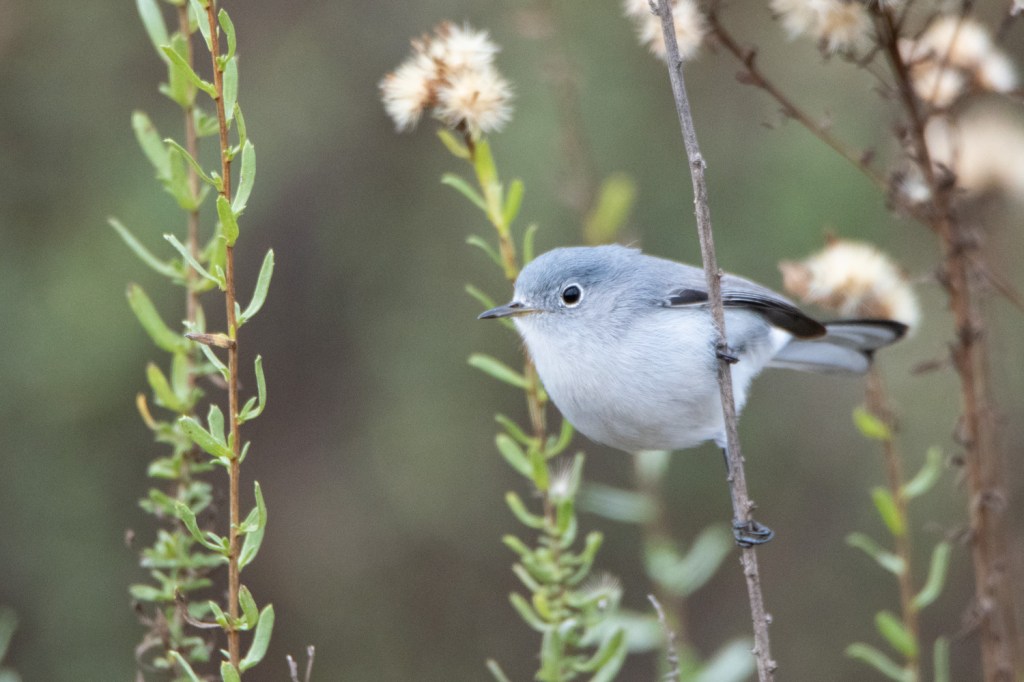
Blue-gray Gnatcatcher (Polioptila caerulea) Colorado Lagoon is an absolute joy to birdwatch at. It’s nestled in a residential area just east of Belmont Shore in Long Beach and offers a nice variety of habitats. The following photos are from a quiet morning in November, but I’m confident this would also be a stellar springtime birding location.

White-crowned Sparrow (Zonotrichia leucophrys), Adult White-crowned Sparrows’ black-and-white striped caps are striking, especially in combination with their bright orange beaks.

White-crowned Sparrow (Zonotrichia leucophrys), Juvenile A juvenile, sporting chestnut crown stripes, was chowing down on some seeds nearby.
Speaking of sparrows…

House Sparrow (Passer domesticus), Male House Sparrows are overwhelmingly prevalent in the United States, but that’s not to say they’re not special birds. The rich plumage on males is often overlooked by restaurant patio patrons.

Scaly-breasted Munia (Lonchura punctulata) I stumbled upon several Scaly-breasted Munias feeding around the lagoon later in the day, a far less common bird in the United States. Birdwatching in Los Angeles can sometimes produce a handful of exotic bird populations that emerged from escaped cagebirds. Scaly-breasted Munias are one of those species, originating from Asia but developing a population in Southern California from a few escapees.

Pin-tailed Whydah (Vidua macroura) Another exotic escapee, a Pin-tailed Whydah, was perched on a telephone wire. Native to Africa, these guys exhibit parasitic nesting behavior, meaning females lay their eggs in other species’ nests.

Orange-crowned Warbler (Leiothlypis celata) 
American Coot (Fulica americana) A large, grassy area with plenty of trees produced a flock of American Coots, Yellow-rumped Warblers, and Cedar Waxwings. This is the kind of place you could pull up a chair and stay a while.
Want the latest? Subscribe for email notifications!
-
Black Skimmers in Long Beach, CA (LBC)

November 20, 2021

Black Skimmer (Rynchops niger) 
Black Skimmer (Rynchops niger) I was sunbathing at the beach with a couple of friends this past Labor Day and noticed a flock of distinctly black-and-white birds standing on the shore. After realizing they were Black Skimmers, I was overcome with panic because I didn’t have my camera or binoculars with me. I told myself to relax and enjoy the moment; I would come back another time. Let me just say, this flock has haunted my thoughts ever since. I returned to the same place a couple of times but never saw any skimmers. Weeks later, the time had finally come.

Black Skimmer (Rynchops niger) 
Black Skimmer (Rynchops niger) Black Skimmer beaks are one of the absolute coolest. Their lower mandible is about a centimeter longer than the top, allowing them to hunt by skimming along the water with their beak submerged. Flocks turn through the air in unison, their black backs and white breasts flashing all at once. “Stunning” feels like an understatement.

Black Skimmer (Rynchops niger) Several Black Skimmers entered the water to bathe, extending their wings and splashing around periodically. As if their appearance wasn’t already dramatic, their spectacular wingspan adds yet another layer of awe.
Want the latest? Subscribe for email notifications!
-
Birding LA: Angeles National Forest (Chilao Visitor Center)
November 14, 2021

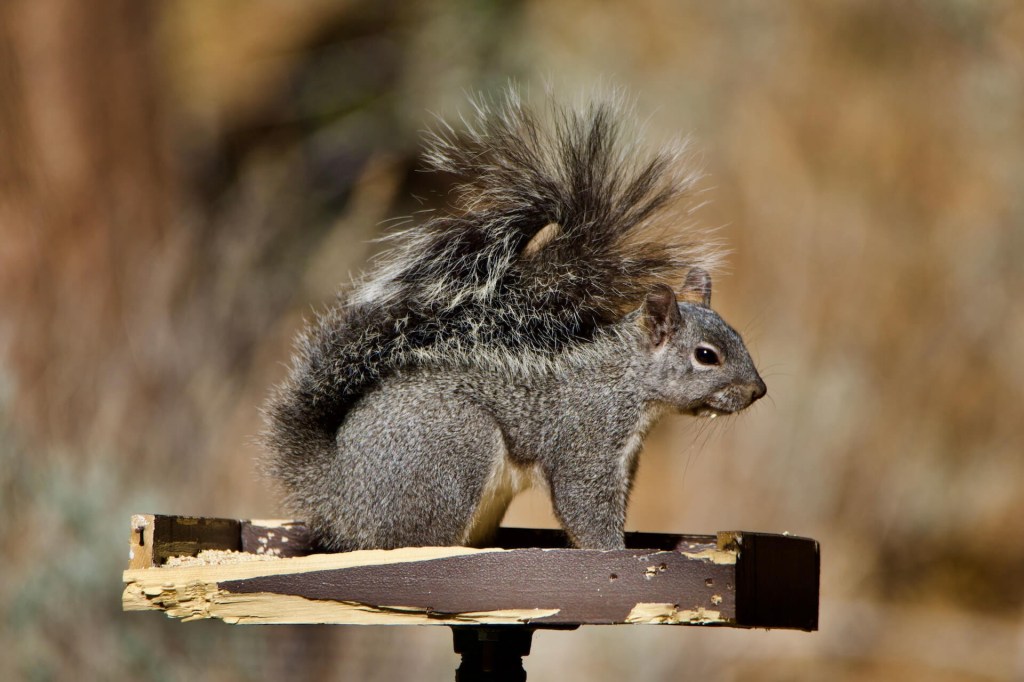
Western Gray Squirrel (Sciurus griseus) Up until this past November, I’d been on the hunt for a White-headed Woodpecker for over a year. I spent eight hours on top of a mountain in Northern California trying to find one in May 2020. The following year, I drove north again to no avail. A map of Angeles National Forest designated Chilao Visitor Center as a White-headed Woodpecker hotspot, so I ventured out in November 2021 with my fingers crossed. Maybe the third time would be the charm…
A note on Chilao Visitor Center before I get too far in: this location is exceptional for views of mountain bird species. There are several feeders well-stocked with seed which did wonders for attracting White-breasted Nuthatches, Acorn Woodpeckers, Steller’s Jays, California Scrub-Jays, Oak Titmice, and Mountain Chickadees.

White-breasted Nuthatch (Sitta carolinensis) 
White-breasted Nuthatch (Sitta carolinensis) As much as I wanted the trees to be filled with woodpeckers when I arrived, I was in White-breasted Nuthatch wonderland instead. They were flitting from tree to tree, hanging upside down and crawling up and down tree trunks.
Meanwhile, Mountain Chickadees let out their iconic “chicka-dee-dee-dee” calls from the tippy top of any and all foliage in the vicinity.

Mountain Chickadee (Poecile gambeli) 
Mountain Chickadee (Poecile gambeli) The only thing better than one big, blue bird are two big, blue birds.

Steller’s Jay (Cyanocitta stelleri) 
California Scrub-Jay (Aphelocoma californica) Next on the mountain bird list: Dark-eyed Juncos. I wish the Dark-eyed Junco in the first photo below had catch-light in his eye, but I still like his pose.

Dark-eyed Junco (Oregon) (Junco hyemalis) 
Dark-eyed Junco (Junco hyemalis) Oak Titmice pairs mate for life. They inhabit the entire length of California into Southern Oregon and the northern/southern edges of Baja California.

Oak Titmouse (Baeolophus inornatus) The Acorn Woodpecker below took a moment to preen his feathers, blessing me with a view of his lush, red crown.

Acorn Woodpecker (Melanerpes formicivorus), Male In the end, my White-headed Woodpecker aspirations were realized on this marvelous day in November. About an hour in, I followed the sound of a call from high-up in a tree. All I could make out was a black body and snowball-looking head. I’d found a female White-headed Woodpecker who was more beautiful than I could have imagined. I basked in the thrill for a few minutes, eventually moving on to other birds. I got an even better view of a male with a red crown patch (photographed below) later in the day and felt plain spoiled.

White-headed Woodpecker (Dryobates albolarvatus), Male Want the latest? Subscribe for email notifications!
-
Digiscoping Birds in Ocean Beach, CA
November 7, 2021
I’ve wanted to write a post about digiscoping for a while now and finally had the perfect opportunity in Ocean Beach, CA, affectionately referred to as OB. I didn’t own a camera when I first started birdwatching and wasn’t quick with identification; I relied solely on taking as many notes as possible about a bird before it flew away. I was usually able to identify the bird based on my mental picture and notes. Other times, however, I wasn’t so lucky and had to endure the frustration of wondering what bird I’d seen.
At some point I stumbled upon the concept of digiscoping, which is essentially taking a digital photo through some sort of an optical telescope to achieve long-distance shots. I digiscope by holding a smartphone camera up to my binocular’s eyepiece, but a spotting scope can be used for the same purpose. There are even special mounts you can buy to attach a cellphone or other digital camera to binoculars and spotting scopes. Digiscoping was a game changer for me. I suddenly had access to an effective identification tool without spending a ton of money.

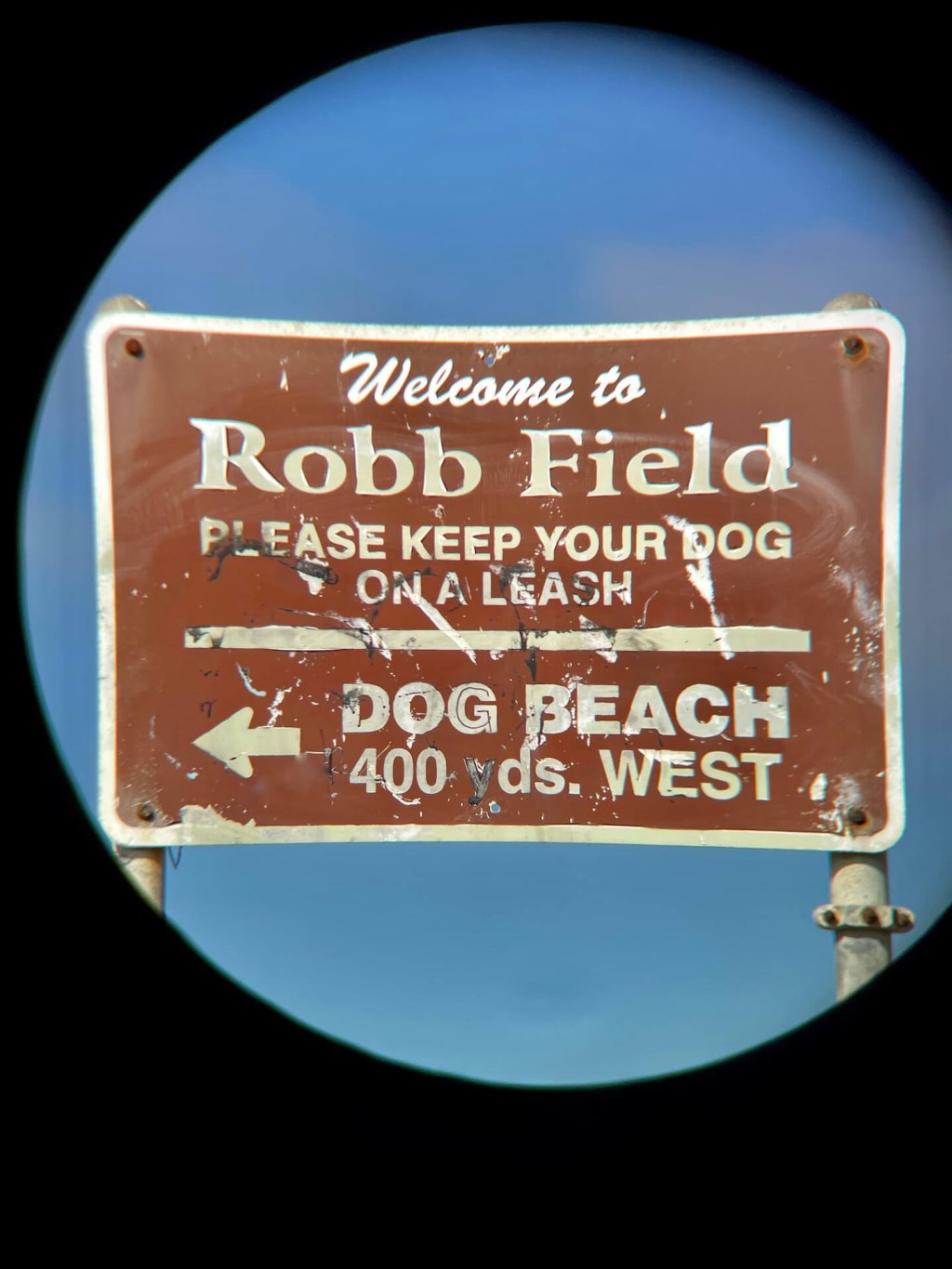
Robb Field and the adjacent San Diego River tidal mudflats in Ocean Beach offer some of the best birding in San Diego. A wide variety of shorebirds, waterfowl, and songbirds frequent the area and are usually in close proximity to the walking path— a perfect formula for digiscoping. Although not seen on this particular day, several parrot species are residents of the area, as well as a Tricolored Heron who has been known to winter along the mudflats.

Reddish Egret (Egretta rufescens) A fellow birder once compared the Reddish Egret gait to that of a “drunken sailor,” which is entirely accurate and has stuck with me. The Reddish Egret above held out his wings and staggered around the mudflats in search of food, cocking his head and neck from side to side.

Snowy Egret (Egretta thula) A Snowy Egret was hunting nearby, lifting his yellow feet out of the water every so often.

Great Egret (Ardea alba) Snowy Egrets and Great Egrets are fun to compare because although they are both big, white wading birds with black legs, they have several distinguishing characteristics. Great Egrets are larger with a thick, yellow beak and black feet compared to the Snowy Egret’s black beak and yellow feet.

Brown Pelican (Pelecanus occidentalis) 
Brown Pelican (Pelecanus occidentalis) 
American Wigeon (Mareca americana)
Left: Male, Right: FemaleThere’s just enough definition in the photo above to make out the male American Wigeon’s black-tipped, baby blue bill and green eye patch.

Mallard (Anas platyrhynchos)
Left: Male, Right: FemaleThe male Mallard’s white collar, green head, and school bus yellow bill are also visible.

Osprey (Pandion haliaetus), Male The male Osprey above appears to have nesting material in his talons and is likely delivering it to his partner to be arranged in their nest. This species is fairly common around Robb Field and oftentimes builds nests on top of the surrounding stadium lights.

Whimbrel (Numenius phaeopus) Whimbrels have long, decurved bills…

Long-billed Curlew (Numenius americanus) …but Long-billed Curlew bills are even longer. They also lack the bold crown stripes seen on Whimbrels.

Marbled Godwit (Limosa fedoa) An entirely different shape, Marbled Godwits have thin, slightly upturned bills. The shot above really highlights this bird’s “marbled” caramel coloration and bicolored bill.

Willet (Tringa semipalmata) Willets look a bit more muted compared to the warm tones on Whimbrels, Long-billed Curlews, and Marbled Godwits, but their flashy white wingbars are striking in flight.

Least Sandpiper (Calidris minutilla) When identifying Least Sandpipers, I look for their yellow legs.

Say’s Phoebe (Sayornis saya) 
Horned Lark (Eremophila alpestris), Male My phone’s camera was zoomed in on the Horned Larks above, eliminating the dark corners seen in other digiscoped photos. These guys were foraging among Savannah Sparrows and a high-profile Lapland Longspur reported days earlier.

Lapland Longspur (Calcarius lapponicus) …and here he is in all his glory! A couple of birdwatchers were nice enough to point me to the Lapland Longspur among the flock of larks and sparrows. I snapped a few photos from afar and we moved on to hunt down a Red-throated Pipit also seen in the area. After locating the Red-throated Pipit, I returned to the mudflat area where my car was parked. I saw a bird perched a stone’s throw away and assumed it was a sparrow, only realizing I had a killer view of the Lapland Longspur after it vocalized. Its distinct rust-colored wing patch and clear facial pattern are evident in the photo above. Digiscoping for the win!
Want the latest? Subscribe for email notifications!
-
Birdwatching in Hollywood ⭐️🎬

October 14, 2021
Birdwatching in Hollywood might sound like an oxymoron, but I’ve been keen on bringing the idea to life. I hear “Hollywood” and think red carpets, movie stars, and glamour. Who says birds can’t be on that list?

What started out as curiosity eventually blossomed into a wonderfully memorable (and surprisingly birdy) day with my sister. I agonized over a map of Hollywood the night before, contemplating which locations would result in a proper representation of birds in the area. I sought a destination that was easily accessible, had a variety of birds, and if possible, a view of the Hollywood sign. Turns out Hollywood Reservoir checks every one of those boxes. The sun is reflecting off the reservoir’s water in the righthand corner of the photo above.

View from Hollywood Reservoir bridge We were greeted by a lovely path cutting through dense foliage around the reservoir. I closed my eyes for a moment to take in the birdsong. I inhaled a deep breath of rich pine fragrance and felt the sun warm up my skin. If I didn’t know any better, I’d swear I was in a forest somewhere hundreds of miles away.

Wrentit (Chamaea fasciata) Wrentits tirelessly bopped around from twig to twig throughout the entire length of the walking path. The bird above was foraging nonstop, occasionally pausing long enough for a glimpse of his icy-white eyes. With those wren-like cocked tails, it’s no wonder their common name is Wrentit.

Dark-eyed Junco (Oregon) (Junco hyemalis) Several Dark-eyed Juncos meandered aimlessly on the ground as they often do in search of food. I was grateful to have gotten a shot that captured the light in his eyes and does his plump body justice. Dark-eyed Junco plumage varies tremendously by geographic location, almost to the point where subspecies look like entirely different species. Some are uniformly gray; some are gray with chestnut backs; others have all-black heads. Regardless of coloration, Dark-eyed Juncos are a symbol of winter in much of North America. ‘Tis the season!

Yellow-rumped Warbler (Audubon’s) (Setophaga coronata), Female Like Dark-eyed Juncos, Yellow-rumped Warblers also have a multitude of subspecies varying by location. Based on her yellow throat, the female above appears to be an Audubon’s Yellow-rumped Warbler. In comparison, Myrtle Yellow-rumped Warblers have white throats.

California Towhee (Melozone crissalis) The California Towhee’s distinctive rust-colored rump is barely visible through the leaves in the photograph above.

California Scrub-Jay (Aphelocoma californica) A group of California Scrub-Jays hanging around Hollywood Reservoir stole the show with their boisterous calls and acrobatic flight between trees.
My sister and I hiked up to the Hollywood sign before we left to take in the iconic view. When in Hollywood, right? There are a few different ways to get to the sign. We took a direct and pretty intense route via the Burbank Peak Trail, but there are plenty of leisurely options if time permits.
Want the latest? Subscribe for email notifications!

